top of page
A Study of the Watcher - Under Development
A Study of The Mirror of Breath 2
A Study of The Citadel - under development
A Study of The Silent Beacon - under development
A Study of The Mirror and the Breath - under development
A Study of Three Tents
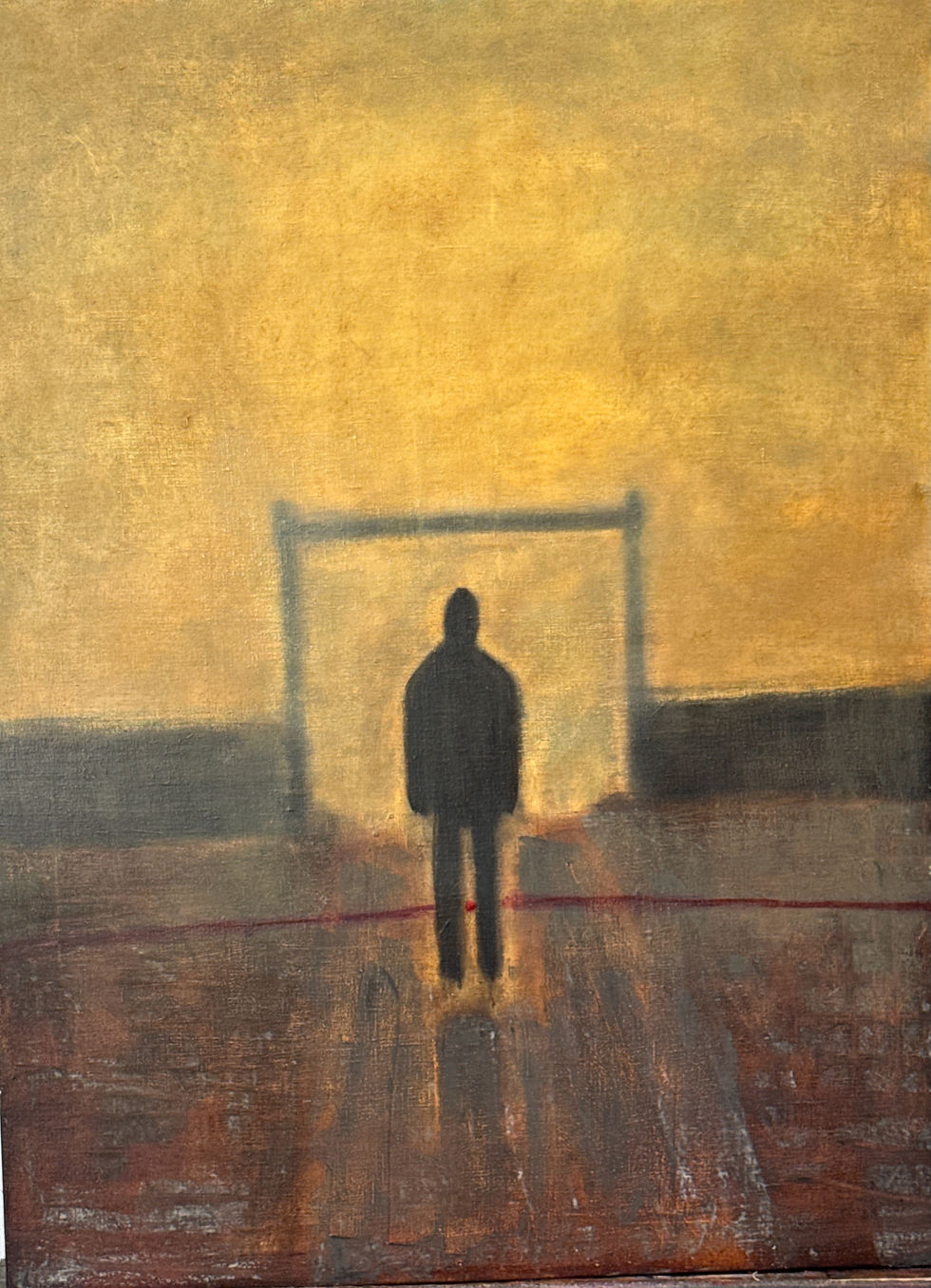
A Stranger at the Gate presents a solitary figure before a luminous threshold. The gate appears as atmosphere rather than structure, a rectangle of diffused light suspended against a muted gold sky.

Layered reds and earthen browns ground the scene, marked by a thin red line at the figure’s feet—a subtle boundary charged with meaning. The stranger stands still, neither entering nor retreating.

The work holds the moment before decision, where crossing begins as awareness rather than action.
A Stranger at the Gate
The Covenant Crossed presents three softened figures walking in quiet procession beneath a heavy sky. A dark horizon stretches across the canvas, marked by a thin seam of distant light.

The figures move below this luminous line, heads lowered, their crossing reading as interior rather than geographic. The covenant remains visible yet remote—steady on the horizon while human bodies continue forward within its shadow.
The Covenant Crossed
A quiet horizon holds earth and sky in restrained balance. Warm ochre gathers below, while a cool, diffused blue-grey sky presses gently above. A thin dark band steadies their meeting.

Built through soft veils, the surface suggests rain or memory settling across the field. Without figures or narrative, the work turns attention toward atmosphere itself—equilibrium sustained between density and openness.
A Study of Mercy
This version of The Listening Field gathers density and weather. A saturated band of yellow stretches beneath a heavy grey sky, while muted green anchors the ground. The atmosphere feels thick, held in suspension.

A single small bird rests near the horizon, quiet but precise, becoming a point of scale and attention within the field. Listening here is not lightness but endurance—presence sustained within pressure and depth.
A Study of The Listening Field #2
Two figures embrace midair, suspended within a field of ochre and muted green. Their bodies lift from gravity, held in a protective yet weightless gesture. A faint, translucent presence hovers behind them.

Below, a ladder tilts upward beside a fragile house form. A solitary standing figure watches from the right, grounded and still.

The work reads as threshold rather than narrative—an imaginal space where shelter occurs within transition. Love becomes the axis that holds descent without denying the ground beneath it.
A Study of The Embrace
A vertical band of gold divides a moss-green field, reading as tree, path, or threshold. Birds and deer-like figures gather on either side, rendered with spare, almost archaic simplicity.

The animals stand in quiet relation to the luminous axis, suggesting sanctuary rather than story. Faint forms within the central band evoke memory inscribed in the land itself.

The work proposes harmony as orientation—life arranged around a steady, radiant center.
Before the Fracture
A slender ladder rises through bands of red, ochre, and muted green, marking a vertical axis within a diffused field of color. The dense crimson ground suggests weight and embodiment, while the pale upper register holds light without spectacle.

The ladder reads less as object than as orientation—a quiet passage between planes. It offers the possibility of ascent without promising arrival, holding tension between gravity and transcendence.
A study of The Covenant Ladder | Sulam HaBrit סֻלַּם הַבְּרִית
A solitary animal stands before a dark, central mountain, its small silhouette measured against monumental terrain. Earthy ochres and muted browns gather across the ground, while the pale sky absorbs light without spectacle.

The composition resists drama. It holds a quiet moment of encounter—presence before immensity. The mountain reads as memory and burden as much as landscape. What remains is attention held steady at the threshold of what must be faced.
Looking up at the Mountain
This work presents a fractured yet unified field of archetypal vision. Divided by vertical panels, the lion, human, ox, and eagle interweave across a warm ground of ochre, red, and slate tones.

No figure dominates. Courage, conscience, endurance, and vision coexist in tension, their edges dissolving into one another. The vertical divisions suggest structure or constraint, intensifying their interdependence rather than separating them.

The image proposes power as composite and relational—an ethic of responsibility held across multiple forces rather than concentrated in one.
The Four Faces of God
A Study of Three Tents — The Murmur of Breath rises as a quiet vertical field. Three pale columns stand close yet distinct, reading as shelters or presences held upright by breath rather than structure.

Soft greys and warmed whites layer gently, allowing light to pass through and return altered. Edges remain porous, as if air shapes their boundaries. The forms share space without hierarchy, holding proximity without collapse.

Within the larger body of work, the painting attends to what comes before language. It invites the viewer to stand in its stillness and feel how breath organizes space, how presence can be shared without urgency.
An Archetypal Study of Three Tents - Murmur of Breath
A Study of the Archetypal Complex III unfolds as an interior architecture shaped by memory and repetition. Tiered arches rise like a remembered city, layered in warm ochres and softened greys that carry the patience of time.

Light drifts without a fixed source, giving the structure an inward glow. The arches read as thresholds, suggesting chambers of psyche held within a larger whole. Near the base, a small white animal appears, introducing instinct and vulnerability into the vastness.

Within the Archetypal Complex series, the work presents the soul as a layered, inhabitable structure. Meaning gathers through return, through walking the corridors of one’s own interior.
A Study of the Archetypal Complex II
The Silikind Queen emerges from a living terrain, gathered by color and ground rather than imposed upon it. Yellows and reds carry warmth and memory, while violets and blues drift above like weather, holding the atmosphere in quiet attention.

Her figure appears softly at the center, translucent and radiant, resting within the field instead of ruling over it. Authority gathers through coherence, not force. A dark animal form moves below, grounding the scene in instinct and motion.

Layered mineral textures slow the surface, allowing light to settle. The queen belongs to an unfolding mythos, offered here as presence: embodied, attentive, and quietly radiant within the world that brings her forth.
The Silikind Queen
Judas at the Threshold | יְהוּדָה עַל־הַסַּף
The Four Faces of God presents a fourfold vision of power held in relation. From a single field emerge the lion, human, ox, and eagle—courage, conscience, endurance, and vision—interwoven rather than ranked.

Echoes of red, white, and blue move as forces, not emblems, suggesting strength braided with mercy and foresight under tension. Authority is distributed. Power must be borne from multiple angles at once.

The work offers a meditation on leadership shaped by integration. Covenant endures only through the ongoing work of holding plurality together.
The Four Faces of God
The Covenant Crossing holds a threshold moment. A horizon divides earth and sky, while a luminous seam gathers at their meeting, suggesting passage rather than boundary. The field is restrained, elemental, and charged.

This is not a crossing of distance but of relation. The work marks the quiet shift from separation to promise, where presence becomes commitment and the future is entered without spectacle.
The Covenant Crossing I
The Gate was Still Open | הַשַּׁעַר עֲדַיִן פָּתוּחַ
The Listening Field unfolds as a wide horizontal expanse shaped by attention. A low, open horizon stretches beneath a pale sky of softened grey and violet, while earthen greens and muted ochres settle below like slow breath across ground.

Distant marks hover faintly, preserving stillness. Brushwork remains permeable, allowing light to circulate. The painting holds a mode of awareness grounded in receptivity, offering space for perception to widen and rest.

Here, presence becomes care. The field listens, and invites the viewer to do the same.
A Study of the Listening Field #5
From the Ashes, Study II centers on a quiet gesture: two children standing hand in hand, facing a soft field of light. They seem to emerge from memory, suspended within a luminous clearing that holds time still.

Violets, greys, and ash-toned browns drift around them like settling smoke. The light ahead glows as an interior horizon, more direction than destination. Their clasped hands anchor the scene—a small covenant formed in uncertainty.

The ground bears traces of aftermath, not spectacle. The work speaks of survival shaped by relation: hope arriving not as proclamation, but as companionship. Two figures. One shared step forward.
From the Ashes Study II- in the Underworld
Two children stand at the center, hand in hand, facing a steady light that offers no promise, only continuation. Around them, bodies rest on the ground. The earth keeps what has occurred. The air remembers.

Rendered in ash, ochre, and umber, the scene turns toward what remains after protection fails and innocence has passed through fire. The joined hands anchor the image: a decision to stay in relation.

From the Ashes (Study) asks what responsibility feels like when repair is ongoing and survival becomes shared. It stands. It holds. It walks forward.
Study of From the Ashes
This painting holds an atmosphere. A band of fire stretches between darkened earth and an ashen sky, dividing soil, flame, and smoke into elemental registers of weight, rupture, and witness.

Built through slow veils of color, the red horizon gathers threshold, wound, and ignition at once. Conceived as the cover for Jerusalem Fumes, it serves as a civic and spiritual preface, preparing the body before language begins.

Human presence is implied. Redemption remains unresolved. What endures is vigilance: sustained attention at the meeting point of faith, ruin, and responsibility.
Jerusalem Fumes (Study 1)
This painting is a cosmological portrait of twinhood. Two luminous forms hover within a shared red field, one cool and reflective, the other warm and forceful. Their relation is held in disciplined distance and inevitable proximity, without hierarchy or collapse.

The red ground carries eros, inheritance, and time, sustaining heat while holding risk. It becomes a field of emergence where difference is tended rather than forced into sameness.

Within the wider mythic arc, the work stands as a pre-conflict vision: polarity held before fracture. It asks whether two stars can grow under one sky without eclipsing one another, and whether love is the steadying of the field that allows each light to become itself.
The Garden of Two Stars
The Border Dream treats the border as an existential condition rather than a map line. A softened horizon divides dense blue-green below from a suspended coral-gold sky above, holding the canvas in threshold.

At the seam hovers a small hybrid form, part house, part gate, part flag fragment, pierced by a thin vertical thread that attempts to bind what the border keeps apart. The image unfolds in dream logic: exile without spectacle, belonging without resolution.

Within The Gateway Series, it marks crossing as an inward event, where the line between nations becomes a line through the self.
The Border Dream
Eikhah va-Or II renders lament as weight. Burgundy and earthen red anchor grief in the body, dense with blood and soil. The thin golden band endures, less promise than persistence under pressure.

Where Study I rises in breath, Study II settles in gravity. Light remains only because the darkness makes space for it.
Lamentation and Light (Study II)
Eikhah va-Or I renders lament as atmosphere rather than story. A lower field of violet and red vibrates with grief, while a narrow band of yellow light hovers above, uncertain and fragile. The upper register holds light as possibility, not resolution.

Here, sorrow rises as cry rather than conclusion. Light does not answer the grief. It listens.
Lamentation and Light (Study I)
She / Her emerges at the threshold between intimacy and abstraction. A feminine profile forms through atmosphere rather than line, shaped by drifting fields of red and blue held in luminous tension.

Blue recedes in contemplation. Red advances with vulnerability and desire. A pale veil softens their meeting, suggesting breath or the space of encounter. The figure has no fixed features. She is an address, not an identity.

Within Falling in Love with an American, this work stands as a counterweight to fractured symbols and descending archetypes. It insists on relation: the presence of the other who cannot be reduced to projection.
She / Her (Study I) | Here I am, toward you
The Betrayer’s Flag reimagines the American flag as a site of moral fracture rather than triumph. Its stripes dissolve into muted crimson, bone, and shadowed blue, while a single gold star descends toward darkness, suspended between fall and illumination.

The lower register deepens into ash and violet, evoking the interior space where loyalty and self-knowledge collide. Drawing on the archetype of the Betrayer, the work does not desecrate the flag. It mourns it. Within Falling in Love with an American, it marks the descent that must precede any honest renewal of covenant.
The Betrayer’s Flag (Study II) |
This painting explores becoming as a material and psychic process rather than a fixed state. A spiral rises slowly from layered fields of green and gold, built through repeated gestures that record return without repetition.

סְפִּירַל הַהִתְהַוּוּת (Spiral of Becoming), it draws on hithavvut, emergence through process rather than arrival. Within The Gateway Series, it marks a threshold moment where form begins to cohere without closing into definition.
The Spiral of Becoming (Study I)
This painting introduces the Silikind Child as a threshold presence, born at the horizon between epochs. Small and centered within a procession of blurred, unstable forms, the child stands among ancestors, future selves, and unfinished bodies of culture and memory.

The surrounding silhouettes resist identity. They thin, fray, and hover between earth and sky, as if history itself were struggling to stabilize. The child is neither protected nor abandoned. It stands exposed, already tasked with seeing what the larger forms cannot yet integrate.

Within The Gateway Series and the mythic cycle The Silikind Wars, this work marks the moment before conflict: the gathering of forms before choice hardens into fate.
The Silikind Child
This work emerged in July 2025 after a period of psychic compression and political exposure in Washington, DC. It shares the inner weather of the Silikind Wars and Gateway works, yet occupies a more contested register. Figures appear as attenuated fragments, suspended between emergence and erasure.

The surface is a field of contention. Personas overlap, interrupt, and fracture into masks. No single figure claims sovereignty. What might seem unfinished is deliberate: the drawing withholds resolution because the psyche it records had none.

Riv Ha-Panim, “the strife of the faces,” names this state of becoming under pressure—identity unintegrated, presence still negotiating which self will step forward.
Strife of the Faces
This painting unfolds as a landscape of quiet appearance. A luminous gradient moves from warmth above into deeper earth tones below, held by a softened horizon that keeps the scene suspended between breath and gravity. Small silhouetted presences surface near the horizon, discovered rather than declared, as if the land itself were remembering them. A faint spiral hovers within the atmosphere, tracing continuity and subtle movement. Within the 2025 body of work, Emergence dans les Collines turns toward gradual revelation, inviting attention to how forms come into view together, patiently, within a shared field of light and time.
Etudes: Émergence dans les Collines
This painting approaches openness as strength. A luminous pink field establishes warmth as ground, from which a golden, tree-like form rises in steady vertical ascent. The figure remains permeable, its light held with quiet density as atmosphere moves through it. Near the base, a subtle spiral marks duration, time folded into growth and memory carried within the present. The work sustains an inviting posture, rooted yet receptive, allowing emergence to unfold without force or finality.
The Tree of Becoming
This painting arose after time spent in Montreal with a close friend and physical therapist whose work is devoted to bodily repair and regulation. It does not depict a treatment or event, but what lingered afterward: a recalibration of posture, attention, and physical presence.

Two simplified standing figures, rendered in luminous yellow against cool blues and dense green, hold a quiet proximity. Their forms remain unresolved, upright yet tentative, as if still organizing themselves within the field. A narrow vertical space between them reads as both separation and shared ground.

Rather than narrating healing as progress, the painting attends to a more elemental threshold: the moment when the body begins to trust its orientation again, and steadiness is restored before words can follow.
Blockworks
This painting holds a remembered image of dwelling across time. A small luminous house gathers at the center of a muted landscape, its interior light pressing gently outward into fields of earth, water, and sky. Reduced almost to a sign, the structure carries a quiet gravity, as though memory itself has condensed into form. A shifting horizon allows atmosphere and depth to meet, giving the house a double posture, both grounded and buoyant. Painted during a period of altered perception, the work treats vision as continuity, where past and present align without collapse. Within The Gateway Project, it functions as a generational threshold, holding the house as an active point of origin from which memory and becoming continue to move.
Untitled
This painting sustains a vertical tension between ascent and descent. A dense blue field gathers below, compressed and weight-bearing, while above it ochre, gold, and earthen red open outward in luminous unrest. The boundary between them acts less as a horizon than as a charged threshold, where one state yields to another through pressure rather than clarity.

Forms in the lower register suggest bodies without fixing into identity, while the upper field remains atmospheric and unsettled, sensed before it is named. Created during a period of altered perception, the work treats vision as encounter, registering contact with ancestral memory and unseen orders without resolving them into symbol.

Within The Gateway Series, it marks a crossing between worlds, sustaining the moment where attention sharpens and the ordinary thins, briefly opening onto something older, wider, and still in motion.
Untitled Feb. 2025
This painting centers on a solitary pyramidal form rising from a green field, suspended between emergence and dissolution. The structure reads less as monument than as remembered shape, its edges permeable, its presence shaped as much by atmosphere as by mass. Light gathers across its surfaces without spectacle, and the apex holds attention without dominance, suggesting a form still in dialogue with what surrounds it. Painted during a period of altered perception, the work approaches vision as contact with deep time and ancestral memory rather than representation. Within The Gateway Series, it functions as an imaginal threshold, where consciousness meets the past through resonance, projection, and the enduring human need to orient itself through form.
The Temple From Afar
This painting arrived as a complete image, felt as necessity rather than invention, as though the form already existed and sought passage into visibility. Its spare composition—a grounded horizontal line, a small vertical figure crowned with a circle, and a larger rectangular mass—creates a charged field of scale and spacing where meaning arises through relation rather than explanation. The forms hold polarity in balance without resolving it, functioning like a diagram that precedes interpretation. Within The Gateway Series, the work marks a cognitive threshold, where intuition moves ahead of language and understanding is sensed as alignment or pressure. It offers not closure but duration, remaining open enough to reward sustained attention.
Untitled
This painting emerged through an altered mode of perception, guided by immediacy rather than plan, as though the image were arriving ahead of conscious thought. Interwoven figures surface in partial emergence, their oil stick and charcoal contours open and permeable, overlapping within a charged pink atmosphere. Gold-toned lines briefly gather around heads and torsos, marking moments of coherence that dissolve back into movement. The work reads less as portrait than as relational field, where identity remains fluid and presence forms through proximity. Within The Gateway Series and The Silikind Wars, it gestures toward intermediary beings and collective intelligence moving through human shape. Its raw materials preserve the trace of becoming, holding the imprint of a crossing where perception and form aligned long enough to leave a mark.
The Silikind Reveal
This painting emerges from the Passover practice of setting an empty chair, a place prepared for one who is awaited or remembered. Structured in three Rothko-like registers, it moves from a luminous upper band of promise, through a deep violet interval of suspension, to a red ground where the faint traces of a chair and table remain. The chair appears as imprint rather than object, a posture of welcome held in readiness, while the table anchors the field in covenant and inherited ritual. Absence carries weight here, sustained as an active presence. Within the wider arc of Jerusalem Fumes, the work continues an inquiry into witness and memory, where waiting itself becomes a form of devotion.
A Study of The Chair That Waits / The Waiting Chair
This painting takes its name from the ancient phrase People of the Book, understood not as identity but as posture, a way of standing in relation to memory, teaching, and ethical inheritance. Horizontal fields of red, gold, and grey unfold like strata of revelation and lived time. In the lower register, three spare tent forms appear, provisional and human in scale, recalling desert encampments shaped by movement and attentive waiting. These dwellings signal encounter over permanence, study over possession. Within The Gateway Series, the work holds a threshold between history and presence, reflecting a tradition sustained through repetition, care, and the shared renewal of meaning across generations.
A Study of, People of the Book
This painting imagines the psyche as a vertical architecture shaped through descent and ascent. Arches, stairways, and stacked chambers rise as a luminous tower that feels discovered from within rather than imposed by design. Warmer upper levels suggest archetypal patterns that precede personal history, while the lower passages narrow and darken, gathering emotional density and forming the chambers of lived experience. Light and shadow remain in dialogue, offering orientation without erasing what is still unfolding. Archetypal Complex presents interior life as both inherited and cultivated, inviting patient navigation of the structures we have built and those we carry within.
Archetypal Complex (First Study)
This painting deepens the inquiry begun in Three Tents, moving toward greater reduction and tonal restraint. Within a near-monochrome field of deep violet, meaning gathers through compression rather than description. The tents persist as subtle pressures in the field, sensed through contour and density, as if remembered rather than drawn. Saturation and stillness carry the depth, allowing the surface to function at once as ground, shelter, and horizon. Within The Gateway Series, the tent remains a figure of waiting, an architecture of patience and fidelity. The work invites sustained looking, where form surfaces through restraint and care rather than declaration.
Three Tents (Study II)
I'm a paragraph. To update me, go to the Data Manager. The Data Manager is where you store and collect data for your site.
The Burning Threshold (Study I)
This painting grows from restraint as strength. A darkened mountain rises from deep red earth beneath a muted violet sky, spare in composition yet slow to unfold. Layered color carries stored force and patient endurance rather than spectacle. At the base, a small arched opening appears, intact and precise, revealing interiority without display. The mountain feels weathered into being, shaped by duration rather than assertion. Strength lives here in containment, fire held within form. What remains is steadiness, a landscape that keeps its center without needing to prove it.
The Mountain with the Hidden Door
Gallery

Our Work

FIlter Artwork
callout-parallax-background-01.jpg

An Open Invitation

The Art Research institute welcomes collaborators, readers, artists, clinicians, thinkers, and institutions who sense that something essential has gone missing - and who are willing to approach that loss with patience, courage, and imagination.

We are not hear to perform answers.
We are here to keep questions alive long enough for something real to answer back.

bottom of page